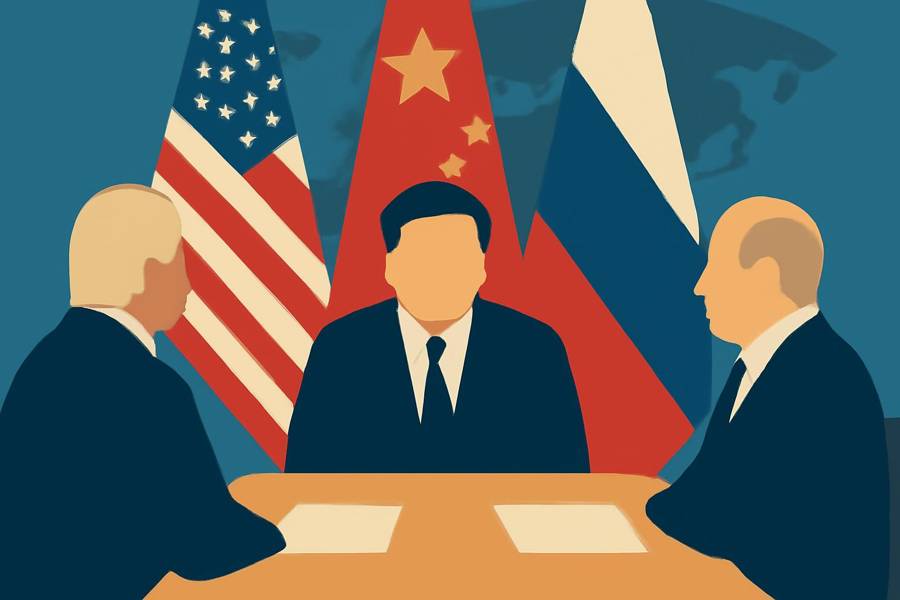
The leaders of the United States, China and Russia held their first-ever three-way talks on Thursday in Shenzhen, China, with the war in Ukraine and nuclear arms control topping the agenda. The closed-door session took place on the sidelines of the APEC summit at Kylin Villa, a government residence in the city’s tech hub, according to the Associated Press and CBS News. The White House offered no immediate readout, and there was no joint statement when the meeting broke up.
CBS News reported the discussion lasted about an hour and a half. Before the trio met together, President Donald Trump held separate meetings with Russian President Vladimir Putin and Chinese President Xi Jinping. In brief public remarks before the trilateral, Trump said the leaders were “making history,” the Associated Press reported. Xi used his opening to frame the gathering as a push for stability and, according to Al Jazeera’s account of Chinese state media, reiterated his call for the eventual elimination of nuclear weapons. Putin signaled that Ukraine would be a central topic, Al Jazeera reported.
Russian state news agency TASS said the talks began midafternoon local time and that work on a possible communique was still underway. TASS also detailed the Russian side’s small delegation in the room, including Foreign Minister Sergey Lavrov and Defense Minister Andrey Belousov, underscoring the focus on security and diplomacy. While the Kremlin has cast the mood as positive, CBS News, citing TASS, noted that Putin left his earlier bilateral with Trump in very good spirits.
The three-way meeting followed days of shuttle diplomacy at the APEC venue. The South China Morning Post described the session as a landmark capstone to a year of stepped-up contacts among the major powers, noting it was the first time the three leaders have sat down together. Al Jazeera and AP said nuclear arms control was a core item on the table, with AP adding that a prior U.S.-Russia treaty framework had expired earlier, a backdrop that raises the stakes for any new dialogue that might include China.
Ukraine’s place in the conversation has been a point of nuance. CBS News reported U.S. officials had earlier downplayed the idea of tackling the war without Kyiv present, but Trump later said he expected it to come up. TASS, for its part, quoted Putin saying his earlier one-on-one with Trump devoted significant time to the conflict. All sides have kept expectations modest; analysts cited by AP and Al Jazeera suggested the most likely outcome is agreement to keep talking rather than any sweeping deal.
Trade and technology tensions were also in the backdrop. CBS News and Al Jazeera noted that both leaders’ public remarks and the APEC program touched on economic stability, supply chains and artificial intelligence policy—issues that feed directly into prices for energy, electronics and other goods. The venue matters too: Shenzhen is China’s flagship tech city, and both CBS News and TASS pointed out the symbolism of holding sensitive conversations there.
Why it matters
A lasting war in Europe and looser nuclear rules can raise risks that hit home—through higher energy costs, market jitters and bigger military budgets. If the three leaders even agree to keep talking on arms control, that could lower the chance of miscalculation. And if they dial down trade or tech friction, it could ease pressure on supply chains and, eventually, prices Americans pay at the pump and the checkout line.