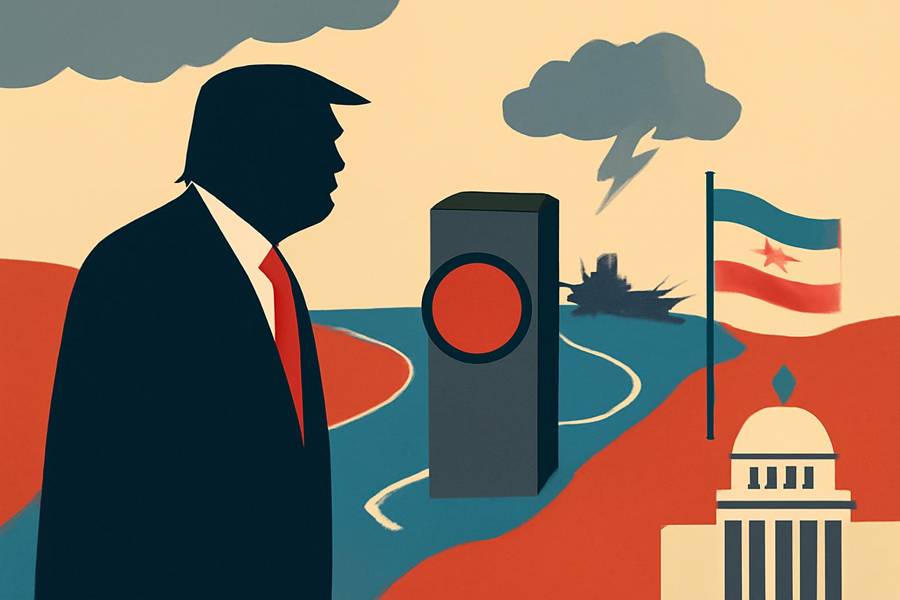
President Trump said Monday the United States could keep the Strait of Hormuz open, could reinstate a naval blockade of Iran and proposed a 20% fee on cargo moving through the waterway to pay for security. The pledge came after a weekend of U.S. and Iranian strikes and counterstrikes around the strait, a narrow passage that carries much of the world’s energy shipments, according to AP News, Axios and CBS News’ live updates.
Axios reported that Trump announced the renewed blockade and the proposed 20% “reimbursement” for safe passage, saying he would allow non‑Iranian traffic. The outlet noted details of the fee were unclear and that a U.S. defense official said the blockade requires formal notice to ship owners before it fully takes effect. CBS News said Trump told Fox News he would keep the strait accessible, and later posted on social media that the 20% charge was intended to cover security costs.
The fighting that framed the announcement has been intense. AP News reported the U.S. military struck multiple Iranian targets in response to an alleged Iranian attack on a container ship. Both AP and CBS News reported that U.S. Central Command used unmanned surface vessels to hit a submarine and a ship maintenance facility at Iran’s Bandar Abbas Naval Base, and AP described it as the first U.S. combat use of sea drones. Axios added that the Islamic Revolutionary Guard Corps declared the strait closed, even as the U.S. said it could maintain a route for commercial traffic.
On the water, traffic has not stopped entirely but has thinned. CBS News, citing maritime data firm Kpler, reported that only a small number of ships transited the strait recently and that some vessels crossed with U.S. support while others kept transponders off amid security risks. Axios similarly cited a U.S. official saying the southern route remained open with some coordinated transits.
The fee plan immediately raised legal and diplomatic questions. AP News reported that the International Maritime Organization said it saw no legal basis for mandatory tolls to simply pass through an international strait. The AP also noted that recently Marco Rubio publicly rejected the idea of Iran charging such fees, a contrast with the president’s proposal. Separately, AP reported fresh alarms and condemnations across the region, including missile alerts in Bahrain and statements from Jordan and Kuwait about Iranian attacks; Iran’s state media reported strikes inside several Iranian provinces.
Markets reacted quickly. CBS News reported that oil prices rose after the latest round of fighting and dueling claims over control of the strait.
For now, the basic facts remain in dispute: Axios and AP both reported that Washington says it could keep the channel open, while Tehran says it is closed. That conflict — paired with the U.S. proposal to levy a 20% charge — points to more arguments ahead over what’s legal on the high seas and who actually controls the world’s most-watched shipping lane.
Why it matters
Trouble at Hormuz can show up quickly in family budgets. If oil stays jumpy, drivers could pay more at the pump and shipping costs for everyday goods may climb. The fee the U.S. wants to collect — if it happens — could also add to the price of moving fuel and fertilizer. And if tit-for-tat strikes continue, the risk of a wider fight that pulls in U.S. forces grows, which is the kind of conflict nobody with a mortgage or a commute is looking for.