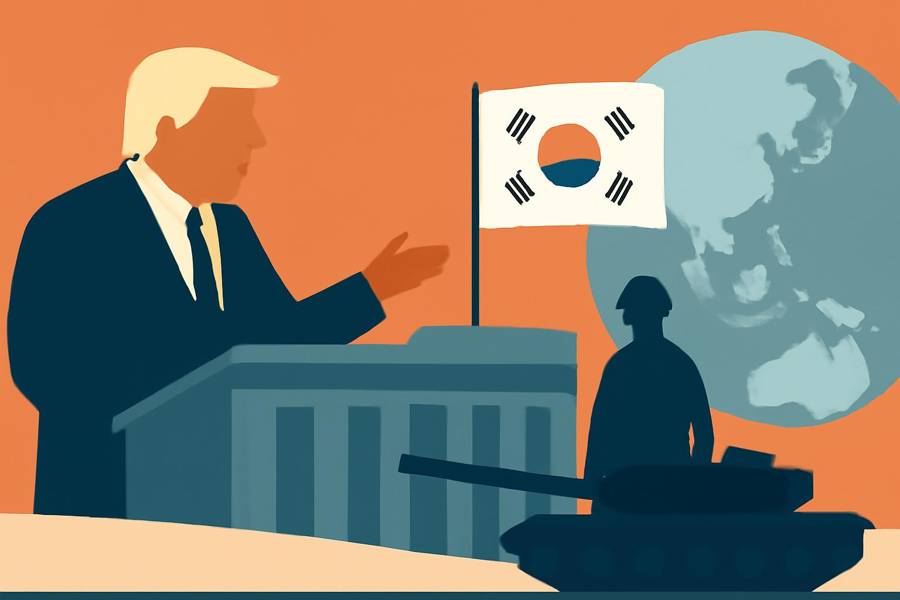
President Donald Trump ordered the Pentagon to scale back joint U.S.–South Korea military exercises, linking the move to his relationship with North Korea’s Kim Jong Un and to South Korea’s response to a U.S. request related to Iran, according to the Associated Press and Axios. He said he told defense leaders to substantially reduce the drills, which are part of the annual Ulchi Freedom Shield exercise. Axios reported the training was set to start Monday; South Korea’s Defense Ministry confirmed the exercises began as planned, AP reported.
In a social media post cited by both outlets, Trump argued the drills are costly and send the wrong message to Pyongyang. AP reported he said South Korea declined a request to assist with U.S. efforts related to Iran. Axios said he cited his relationship with Kim as another reason to cut the scope.
The joint training, known as Ulchi Freedom Shield, is designed to strengthen combined readiness, according to U.S. military statements referenced by AP. AP reported the plan called for several days of activity involving thousands of South Korean troops and a range of complex scenarios, including live-fire and logistical exercises. South Korea’s Defense Ministry told AP the drills opened as scheduled.
The timing comes as North Korea has resumed ballistic missile testing, AP reported. Axios noted that test activity could be a protest of the drills, which North Korea routinely denounces. AP also reported criticism from some U.S. lawmakers, who said weakening the exercises could be a mistake and reflected concerns that training cutbacks can erode readiness.
Axios added a broader force-posture wrinkle: a U.S. aircraft carrier is being redeployed from the Pacific to the Middle East, temporarily reducing carrier presence while the administration also trims the Korea drills. While that move was reported separately, it underscores why defense planners watch exercise changes closely in a region where U.S. presence is a key part of deterrence.
Both outlets stressed what this decision signals. Axios framed it as an extension of Trump’s arguments that large-scale drills are expensive and provocative. AP connected the order to the president’s public pressure on allies in other theaters and to his outreach to Kim. Neither outlet detailed exactly how much the Pentagon may cut from this year’s training; the order came after preparations were already underway.
Why it matters
For American families with service members in Korea, regular combined training is what keeps U.S. and South Korean troops ready to work together if a crisis hits. Cutting back could save money in the short run but may reduce practice time for complex missions. It also sends a signal to North Korea and to other regional players watching whether Washington will keep up its defense commitments in Asia. And with attention and assets shifting toward the Middle East, the balance of U.S. focus is in play — which can affect everything from troop rotations to the stability that underpins trade across the Pacific.