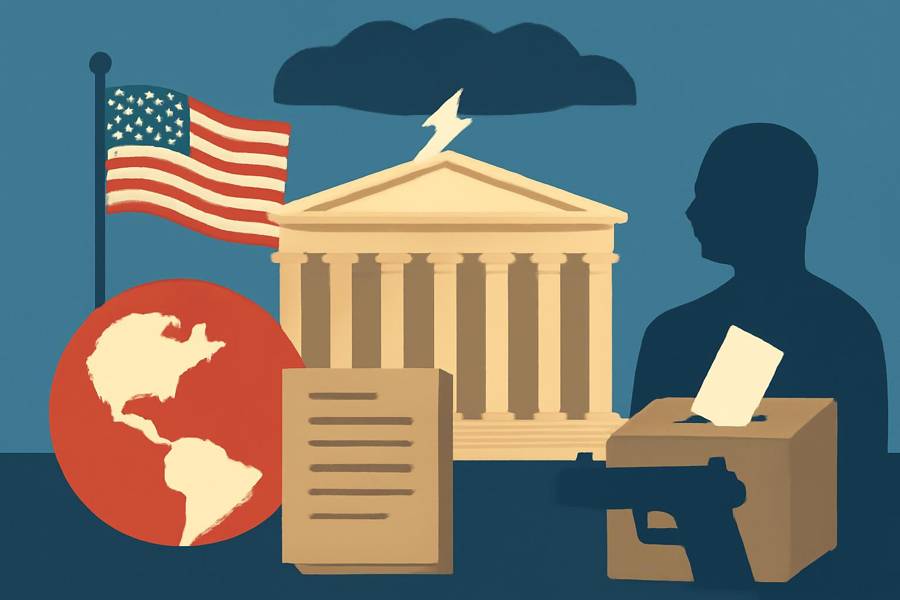
The Supreme Court opened its new term on Monday, October 5, 2026, with a climate liability case on day one and major fights over immigration and guns queued up for the months ahead. The justices heard arguments in a Colorado dispute over whether oil companies can be sued in state court for climate-related damages, while cases testing President Trump’s immigration policies and state bans on semiautomatic rifles are scheduled later this fall, according to CBS News, the Los Angeles Times and the Associated Press.
The Colorado case pits Boulder County against Suncor Energy and Exxon Mobil. At issue is whether federal law blocks state-law claims that seek money for local harms tied to climate change. The Los Angeles Times reported that Justice Samuel Alito has recused himself, raising the possibility of a 4-4 split and noting the court also asked the parties to brief whether it even has jurisdiction at this stage. Christian Science Monitor added that a tie would leave the Colorado Supreme Court’s ruling for Boulder in place but set no national precedent.
On immigration, the justices are set to hear two significant cases. One challenges the administration’s practice of deporting certain migrants to third countries rather than their home nations; the court previously allowed those removals to continue while litigation proceeds, CBS News and AP reported. A second case examines the administration’s view that some immigrants awaiting removal can be held without bond hearings. The Washington Post said both policies are central tests of the president’s broader immigration agenda and are among the term’s potential blockbusters.
Guns are also front and center. The court may consider challenges to state and local bans on AR-15-style semiautomatic rifles from Illinois (Cook County) and Connecticut. Lower courts upheld those restrictions under the Supreme Court’s 2022 “history and tradition” test for gun laws, and arguments are set for December, CBS News and the Washington Post reported. AP noted that several states have similar prohibitions, so the ruling could clarify how far states may go in limiting these weapons.
The docket reaches beyond those headline fights. In November, the court may hear a religious-rights case involving a Catholic preschool’s participation in Colorado’s universal pre-K program, according to AP and CBS News. And in December, the justices may weigh Arizona rules requiring proof of citizenship for certain voter registrations and governing when officials can purge voter rolls, CBS News and AP reported.
The new term opens amid continued scrutiny of the court itself. Fox News highlighted a recent poll showing low approval and significant concerns that the court is too conservative. The Washington Post noted that the court’s decisions and any emergency election disputes could intersect with November’s midterms, even as the justices consider whether to take up additional cases tied to the administration’s agenda.
Why it matters
What the court decides this term could change who pays for climate damage, how quickly the government can remove or detain migrants, and whether states can keep bans on popular semiautomatic rifles. Those rulings would shape costs for cities and consumers, due-process protections at the border, and the gun rules many Americans live under. With arguments stacked through the fall, the practical results may land just as voters are weighing their choices in the midterms.