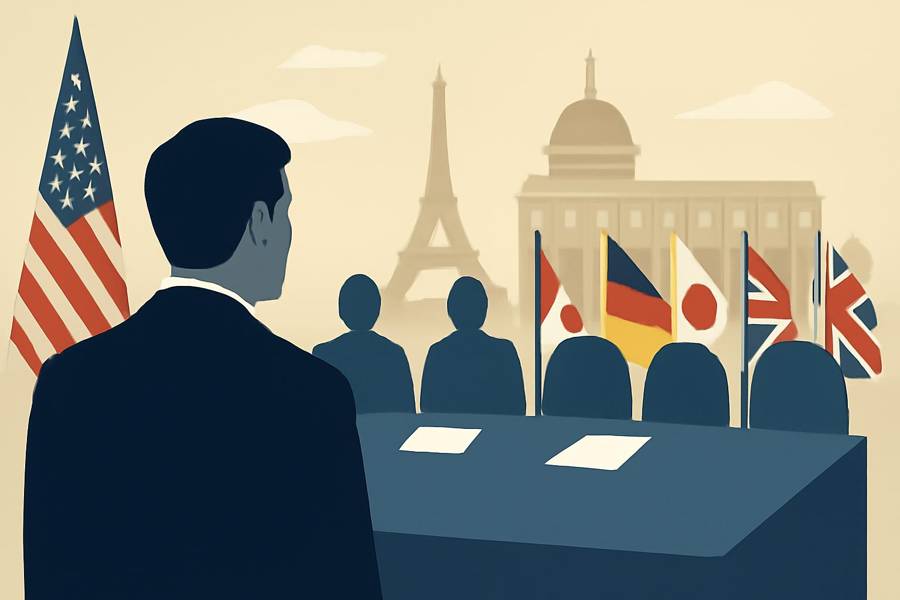
U.S. official Marco Rubio met his Group of Seven counterparts in Paris on Monday, the first time allies have seen him in person since the recent midterm elections. The agenda is crowded — Iran, Ukraine, energy prices and even artificial intelligence — and the question hanging over the talks is whether Washington’s approach could change after the midterms, according to the Associated Press and The Washington Post.
European foreign ministers plan to press Rubio on two fronts: preventing a shaky Middle East from sliding back into direct U.S.–Iran confrontation and ensuring any path to end Russia’s war in Ukraine is fair to Kyiv, Agence France-Presse reported. AFP also noted that U.S.-mediated contacts between Russia and Ukraine were expected in Abu Dhabi this week, a point also highlighted by The Washington Post.
Rubio arrived with a blunt public message on Iran. He said a diplomatic deal was not close to a breakthrough and criticized what he described as unrealistic Iranian demands, Anadolu Agency reported. AP said he has emphasized that allies want clarity on next steps, even as the administration says it prefers diplomacy.
The venue itself became part of the story. Reuters, via the Japan Times, reported the meeting was shifted at short notice from Marseille to Paris for security reasons after weeks of protests across France. Le Parisien, citing French officials, said the move was made for scheduling reasons. Either way, the two-day gathering is taking place at the Quai d’Orsay in central Paris, Le Parisien reported. AP added that the talks coincide with large demonstrations in several European cities, including Paris.
Back home, the political backdrop is hard to miss. AP and AFP both noted that the midterm results gave Democrats control of Congress, a shake-up that partners are watching closely for signals on U.S. aid to Ukraine, policy toward Iran, and coordination with Europe. The Washington Post noted that the G7 agenda includes a working session on AI alongside discussions of humanitarian aid and energy costs.
Rubio’s own schedule reflected those priorities. The State Department’s public schedule for Monday listed meetings with European counterparts, a working lunch on international crises, and a session on artificial intelligence, capped by a meeting with French officials. The French hosts also invited non-G7 partners to parts of the program, AP reported, and officials did not expect a formal joint communiqué by the end, according to AP and the Post.
On Ukraine, AFP said European ministers want assurances that any U.S.-backed settlement would not undercut Kyiv or outsource security guarantees over their heads. Rubio has said allies are focused on what postwar European security architecture might look like, AP and the Post reported. On Iran, Anadolu Agency reported that Rubio defended the administration’s approach to the conflict while reiterating that Washington is willing to explore diplomatic options despite limited progress so far.
Why it matters
What the U.S. signals in Paris could affect energy prices, shipping lanes, and the pace of support for Ukraine — things that hit home in fuel costs and global stability. Allies are testing whether divided government in Washington means policy shifts, slower decisions, or steadier hands. Clear answers can reduce uncertainty for markets and for families watching world crises ripple into everyday life.