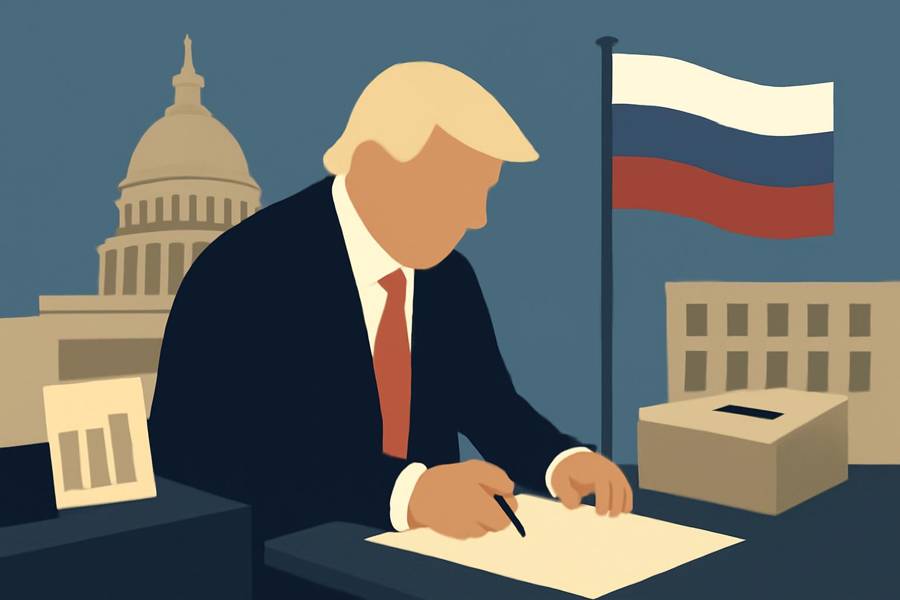
President Trump signed an executive order placing on hold a slate of tough new Russia sanctions that Congress passed and he signed into law, saying the pause is “in the national interests.” The move came shortly before the law’s implementation deadline and immediately set up a clash with bipartisan Russia hawks on Capitol Hill and with Ukraine, which has urged Washington to tighten economic pressure on Moscow’s war machine.
The White House order lays out how to implement the recently passed sanctions law — then invokes a waiver in the statute to suspend sanctions, restrictions and duties for now. It also says the president sent Congress a required certification explaining the national-interest rationale and notes that earlier Russia penalties imposed under separate executive orders remain in force. According to the order’s text, the law had authorized steep trade measures, including high duties and tariffs aimed at major buyers of Russian energy and at entities accused of facilitating sanctions evasion; those measures are waived unless and until the administration changes course. (The White House, Official Presidential Actions.)
Axios reported that the decision drew swift criticism from lawmakers who wanted the administration to enforce the new law, including Democrats who urged fuller implementation. CBS News similarly reported that the waiver blocks the law’s biggest bite — tariffs and other penalties aimed at major purchasers of Russian energy — just as they were set to kick in. The Washington Examiner noted that the order explicitly uses the statute’s waiver authority to put the penalties on hold indefinitely.
Ukraine openly objected. The Associated Press and Al Jazeera reported that President Volodymyr Zelenskyy urged supporters to rally behind the sanctions package and said he hoped it could be revived. The Guardian added that under the law the president faced a deadline to either impose the measures or waive them, and that a Russian presidential envoy publicly praised the suspension.
The pause followed another policy shift that intensified the fight over how far to squeeze Russia’s energy sector. Axios, AP and Al Jazeera all noted that the White House recently announced a deal to allow purchases of Russian diesel to try to ease fuel prices. Critics in both parties argued the diesel step and the sanctions waiver would relieve pressure on Moscow without clear benefits to consumers. Supporters of the pause point to the order’s language about national interest and the administration’s ability to revisit the waivers if circumstances change. (Axios, AP News, Al Jazeera.)
Bottom line: the law remains on the books, but the core enforcement teeth are sheathed for now. The administration has directed trade and national security officials to monitor global oil purchases and sanctions evasion and to recommend “further action” if needed, according to the order. How long the pause lasts — and whether Congress tries to narrow the waiver authority it wrote — is the political fight ahead. (The White House, Axios.)
Why it matters
The pause could reduce immediate trade friction for countries buying Russian oil and may avoid near-term price spikes tied to new tariffs, but it also eases U.S. economic pressure on Russia’s war economy. For Ukraine, it signals a cooler wind from Washington at a moment Kyiv wants more, not less, squeeze on Moscow. At home, it sharpens a classic separation-of-powers tussle: Congress wrote a tough law with a waiver; the president chose to use it. Voters are left to judge whether that call helps their wallets or weakens U.S. leverage abroad.